 By Cindy Bailey 11.22.05
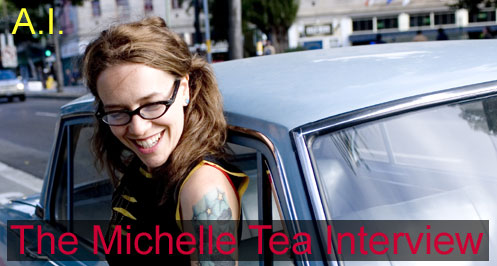
Photo by Lydia Daniller
Michelle Tea is a burst of positive energy. Vibrant as the colorful tattoos that run the length of her arms. Alive, impatient, and prolific. Her writing is rich with story and brutally honest. And as a literary leader, she's helped define and shape a local underground subculture of queer women writers and artists.
When I say prolific, I mean: she's written four memoirs, including the award-winning Valencia and her latest, Rent Girl , an illustrated graphic novel she created with illustrator Laurenn McCubbin that details her former life as a sex worker. She's published one book of poetry, The Beautiful , and was editor of two anthologies, plus a guest editor of a third. She contributes regularly to numerous anthologies and publications, such as On Our Backs , Girlfriends , The Believer, and The San Francisco Bay Guardian , and her first novel, Rose to No Man's Land, will be coming out in February, 2006.
In addition, she also writes horoscopes, along with Jessica Lanyadoo, for The San Francisco Bay Guardian and other publications.
She's won numerous awards for her writing, and yet she's sometimes more known for her literary shows than she is for her writing. Tea currently runs the popular monthly Radar Reading series at the San Francisco Public Library, and she is also the creator, along with Sini Anderson, of Sister Spit, a girls-only open mic event that ran from 1994 to 1996, and then hit the road on tour across the country from 1997 to 1999. Winning The San Francisco Bay Guardian's Best of Bay award for “the best place to hear sliver-toungued she-devils,” Sister Spit helped cultivate the talents of many women writers and performers, such as Beth Lisick and Tara Jepsen.
Tea has also gone on tour with the Sex Workers Art Show and The Wasted Motel Tour, among others. “I do other tours mainly when I have a book coming out,” she told me. “I don't drive, so I have to curate this whole show, and then find people to drive.”
I sat with Tea (and her cat) in her apartment in North Beach to chat about her writing life.
I read you always wanted to be a writer. How did you get started? And when?
I got started when I moved to San Francisco in '93. I had just come out of this really screwed up relationship, and I needed something to devote myself to. I just decided I'm going to go to San Francisco and I'm going to write.
So when I came here, I started going to open mics. There was one every night of the week, and there were people there who had a sensibility I could relate to. They weren't coming out of universities. It was a really working class sensibility, a punk-informed sensibility. They were happening in places [where] I felt really accepted and comfortable, like bars and coffee shops. As intimidating as it always is to get up on stage, especially when you haven't done it before, it was the least intimidating way to do it [get my writing out].
So you chose the open mic scene as opposed to staying in your room and writing.
Yeah. I never wanted to do that. That would have felt very futile to me. I'm a really sociable person, and I didn't want my writing to just sit. I didn't want to write for no reason. I wanted to have an audience or have my writing be out in the world, but I had no idea how to do it. It was so wonderful that I didn't have to think about it for too long. I came, I found this scene, and I thought great, this is totally what I want to do. I didn't even know what I was looking for, but this was totally what I was looking for.
How did you choose San Francisco?
I flipped a coin. It was between here and a lesbian separatist land in Arizona. My girlfriend and I broke up, and I had been kind of obsessed with this really bad relationship. I was really young, and I didn't know what to do with myself when we broke up. My best friend from when I was younger lived out here, so I flipped a coin and came and stayed with them.
Did you start with poetry?
I did.
And you took those to open mics?
Yes.
How did you decide on a genre, like poetry?
I didn't. It's just kind of what came out of me right then. I wanted to tell stories about my own experiences, and poems were the way they came out. Little, fired-up emotional blurts was kind of where I was at and how I was able to get a handle on what my material would be. They were pieces that I could write at work, or in between working and not working. They could just occur to me when I was walking down the street. I could stop and jot them down.
I was so overwhelmed by my life at that time. I had just moved here, I didn't know what I was going to do, and I was contending with both this brand new present and my past, which I felt I really needed to look at and understand. There was a lot of mental activity, and poems were a really good way to get the burst out.
How is it that you also became a performer, and which came first: writing or performing? Or did they go together?
Writing came first because you have to write the thing before you get on stage. Performing was just a way to release my writing, a way for me to be a part of a writing community, to let people know that I exist, to hear what the work sounded like, to give it a certain life. I was also selling my chapbooks, so there was a written page aspect to it too.
How much did your home/family life influence you as a writer and how?
I write memoir, so the activity of home and family life have influenced my material.
Did your home or family life push you to become a writer?
I think I was just born a writer. I really do. I always felt the urge to be writing and documenting. I remember being six years old and just having had an operation, and trying to write a book about a girl who just had an operation. I think whatever family I was born into would have wound up fodder for my writing. It's so mysterious. We never really know, you know? Maybe if I had different genes, I wouldn't be a writer.
But being a writer is just like, so out there. … I wasn't encouraged to do that, but it was more because it just seemed like encouraging someone to go and be a movie star. Who gets to do that?
Why did you move from poetry to prose?
I felt like the form of poetry couldn't contain the story I wanted to tell. I wanted to shine a wider light on people and incidents that I had been touching in my poems.
Do you still write poetry sometimes?
I don't. I don't have the mental space to let a poem in. I feel like life the way that it was… I just had a lot of open space to dream, and I think that's what you need for poetry.
You do so much. How do you choose projects to take on? You write books, edit anthologies, run events. How do you choose?
Sometimes I choose me a little. I've always been curating shows. I like curating shows as much as I like writing, so I have to be doing that to be happy, and to feel like I'm doing something I'm supposed to do. So, doing Radar [Reading series] is perfect because it's once a month. I couldn't do a once a week thing anymore.
And I need to be working towards a new book at all times. What I'm working on now is a script for a comic book that I'm doing with Laurenn McCubbin, who illustrated Rent Girl . We went on three regional tours for Rent Girl . … We got great responses and felt really buoyed by that. So, we felt we've got to do another project together. So we're doing this. That's what I'm working on, and I'm taking notes for other possible things.
But I have to be working on a book, and I have to be working on a series. For other stuff, people ask me to do things and I either do them or I don't.
How do you manage your time among the many different projects?
I do manage my time. I have to designate some days working days and some days off. On most of my days off, I end up doing some work – it's inevitable. But on my work days, I definitely don't lounge about. … What I work on is dependent on whether or not I have a deadline for one of my paid writing things. If I don't, then I will work on creative stuff. But I don't do as much creative writing as I would like to.
On my days off I don't let myself return any phone calls or check emails. I still end up doing that sometimes, but it's OK if I don't. I just have to make peace with the fact that I can't keep up with the emails. [Otherwise,] that's all I'd be doing.
When I first started writing I was such a devout slacker. I was against the idea of having a career. I just wanted to be an artist in the world and experience the world and write. So it's funny now to just feel like I have all these responsibilities. Sometimes I have to realize, ‘No, remember how you were?'
What is your writing process? Does it depend on the type of writing project?
I think so. It really does. My process for writing all my memoirs was really different than my writing process now. I would have a running list of various things I wanted to explore, either a person or an incident, anything that got my inner narrator running. …I'd have a list inside my notebooks, and I would go to bars and cafes after work and write until they closed.
I didn't set out to write a certain book. I was just amassing all these stories. Because they had a consistent narrator, they ended up becoming books. I would just have to look at it and say, ‘OK, all I have to do is fill in these gaps, and that's a complete book.'
But now, writing fiction… I don't drink anymore, so I don't write at bars anymore, so that's really changed my writing process.
I think writing fiction is hard.
Yeah. It was. Writing Rose of No Man's Land was crazy because I didn't know what I was doing. I didn't have any faith that I could actually do it. I was really preoccupied with whether this character is believable, is this realistic?, all this stuff that now, I don't even care. It's fiction, it's OK to write a character that wouldn't really exist in the world. But I am just so into this authenticity mode from writing memoir that I'm like, is she real?
I didn't have an outline. I'd just sit down in stark terror and make them [the characters] do things. It's a really manic book... And now, I feel like, oh-my-god, I will not write fiction without some sort of chapter outline or chronology or something to work off of.
I mean, I could do it like that again. At the end of it all, I really like the book. It works. But I think it would be easier on me psychically to have something to work from.
So when I started working on the script for the comic book, I ended up spending three months just really getting back story, developing characters, putting together a timeline of activities, and that's what I'm working from now.
… And it's not like you can't go off of your plans. But it's very comforting to have a structure.
Do you write every day?
No I don't. I could probably benefit from some more discipline in that, but I just kind of get up on a work day and try to figure out what I feel like doing, what I've neglected, what deadlines I have. Today so far, I read some stories for the anthology and invited some more people to participate in those. I checked some emails, made some phone calls. I have some deadlines tomorrow. I'll probably do non-creative writing today.
But oh, I also have a writing duo, in which once a week I meet with a friend who's a writer who's also working on science fiction – very fantastical, creative writing, and that's what the comic book is, fantastical. So we meet once a week and write. I just did that last night, and I feel I got a lot of really good creative writing in.
Do you set goals for yourself? How do you motivate to write?
I have to write at this point because if I don't I will have no money. Before that I felt I had to write or I'd have no life. I was just working these crappy jobs, and I just knew that if my life was going to have any sort of meaning or if there was an opportunity for it to ever get interesting, it was going to happen via my writing. I just really wanted to participate in the world, and it seemed to me my only in. So I was really motivated that way.
So now, OK, I'm in. I've got to keep it going. I know that I have to keep producing; it's the only way to stay in the game.
… Deadlines imposed by other people are great. I can't impose them on myself.
What inspires you and keeps you writing? Is it this idea of being a participant in the world?
Yeah, that's the base motivation for it. And then there's what inspires actual stories. Those are two different kinds of things.
What was your first break as a writer?
Hhm. I think probably starting the Sister Spit open mic because it gave me an audience. Even though it was a local audience, it was an enthusiastic and devoted audience. It let me know there was a way I could be a writer even though I hadn't been published, which seemed like so out there for me. But I kind of gave that to myself in a way. Getting my first book published, that was a really big deal. That I suddenly had a published work was crazy.
And then there was another break: Valencia winning the Lambda award, and getting published under MacAdam/Cage Publishing with my next book feels like a really big break.
They're all so intertwined, it's hard to pick which one is the big one.
What have been your biggest challenges or obstacles, either in your career or writing process?
I think the biggest challenge is to challenge yourself and not rest in stories or themes or ideas that you know, that have worked for you in the past. I felt I really had to write fiction, even though a lot of the ideas and themes in the fiction are present in my memoir. I had to do something different, because I could get trapped in the talking Michelle Tea puppet, writing about my own life again and again and again.
How did you fall into writing for the various anthologies and publications that you do, in general? Do people come to you with them?
Yeah. Entirely. That's how it's happened. I'm asked to write one thing, and then I just ask, can I keep doing this? Can I write more?
I did go to Girlfriends and ask them because I was asked by this other, competing lesbian magazine to write a weird soap box essay. I ended up writing this really weird essay about how – and granted I was out of my mind at this time – I decided not to wear a pad or a tampon for a period and just bleed all over everything and make the world deal with women's menstrual blood. … They wanted to take all these parts out. I said, come on, you're a lesbian magazine. So, I got really upset and contacted their competitor, which is Girlfriends magazine. Will you publish this? And they said yeah, and I've been writing for them ever since.
But all the other ones I was contacted by them, and once I had that contact, I just kept using it.
How about making a living as a writer. Do you feel you've been able to do that?
Yeah, amazingly. I'm completely doing that, and I've been doing it since 2003, which is when I quit my day job, which kept getting pared down. I was terrified to let go of it (working at a bookstore, which I had been doing for about five years). I was getting invited to speak at different colleges, and there was this one month where I realized if I kept the bookstore job, I wouldn't be able to do all these other readings and I'd actually be losing all this money. It just kind of happened like that. Things kind of converged. I went on the Sex Worker Art Show tour, which I got paid to be on, and then I got an advance to do the Without a Net anthology, and suddenly I had the little safety net to be able to freelance. Because your check takes a while to come in, you need to have a little egg to live off of while you're waiting, and I never had that. Then I did.
All the things that I do together support me, but any one of them on their own would not. The books alone don't support me. The horoscopes and articles don't support me. The going to speak at colleges and doing paid readings don't. But all of them together do. For Radar [Reading series], I've gotten a couple of grants, last year and this year, and that's made a huge difference.
What advice would you give a writer who wants to follow in your footsteps?
In my footsteps? They're very specific footsteps. There's a lot of different footsteps you could follow in. I think it's really important to not be goal-oriented, to not have expectations, and to really focus on your writing. Of course you want to get published. Of course you want success. But that can't be the focus. I just know people who get wigged out over their writing careers, and I think if you get into that state, no matter how many good things happen to you, you're just in that state.
I just feel you need to keep your feet on the ground, and you need to know you're just another writer in the world, and you've got your thing to say, and you're going to figure out how to say it and do it. If you don't see a space in the world for you and your writing, then create it. Start a reading series if you feel you can't get in on other people's reading series. If you feel alienated, do something. If you feel you don't have publishing connections, publish your own book and get it out. Every little thing you do like that is a step, and you can build on it. It's not like that's all what you have to do for the rest of your life. I just feel if you can take it into your own hands and be more do-it-yourself about it, the more empowered you're going to feel, and the more you'll be able to devote yourself to the actual writing and not get hung up on rejection letters and stuff like that.
What does the future hold for you? Do you have an ultimate goal?
Well, there's things I'd like to do, I just try not to get too attached to them. Yeah, there's a lot. What's coming up is that I'm going to do this Sex Workers Art Show tour in the winter, and my book, Rose to No Man's Land , is going to come out while I'm on that tour, so when I'm done I'm going to be doing a book tour. Hopefully by then I'll be done with the comic book, for which we have an agent who's working on selling it for us, and then I'll be able to write either another novel or I'll try a memoir again.
But also, Laurenn [McCubbin] and I have optioned the rights to Rent Girl to the executive producer of Queer As Folk , so we're really hoping that we're able to meet all the right people and have it all come together so that we can have that made into a cable TV show – that we would participate in and write for. He's having a hard time right now finding people who are open to the idea of a TV show that's all about prostitutes because the media idea is that it's … really sad and pathetic and depressing.
I think it would be fascinating for people who have no exposure to it.
Totally! It would be so great. It would be an incredible and revolutionary show, and I totally believe it's going to happen. I just hope it's going to happen soon. I am trying to kind of weasel my way into television in Los Angeles. I pitched to one production company a bunch of ideas, and my sister and I wrote a really thorough outline for a TV show.
How do you keep track of all these projects?
It's hard. It helps that there's so much going on because things in L.A. take forever. It's so slow. So it's good that I've got a lot to do here or else I'd be wigging out and neurotic.
Yeah, they have a lot of people get involved in the decision making process down there.
Yeah, and you're relying on other people. It's really good to have things that I don't have to rely on anyone for, that I'm in control of, and I know that I can make things happen.