Showing posts with label Litquake. Show all posts

Wednesday, July 2, 2008

Wild Women Writing: A Treasure of Tips from Travelers' Tales' Larry Habegger

By Cindy Bailey 5.1.06 (for 3.1.06)

The first Wednesday of every month, the Wild Writing Women host a free literary salon with a featured speaker at the Monticello Inn in San Francisco, and – as with so many other events – I kept meaning to go but didn't.

And then finally, after a year, I did. On March 1 st . That month, the Wild Writing Women featured Larry Habegger to speak on the art and craft of the personal travel story. Famous for starting up the award-winning Travelers' Tales series ( www.travelerstales.com ) along with James and Tim O'Reilly, Habegger is also an accomplished travel writer. I had heard him speak at San Francisco's LitQuake, and I remembered I liked him. I really liked the Travelers' Tales books, too.

The salon would start at 5:30. I had just enough time to make it. There was only one problem. What would I do with the three-month old baby sitting on my lap? (This, by the way, is the reason I'm only getting to a write-up of the event now. Who knew having a baby would consume so much time you'd be lucky to sneak in a shower, let alone find a moment to write?) Either Julien came with me, or I didn't get to go. I had no choice.

I strapped Julien to my chest and ran out the door. At the Monticello Inn, it was easy to locate the salon by the 30 or so writers (both men and women) mingling in a cozy section of the lobby. The room had cushy couches and chairs, warm rugs, and a fire place. Wine was being served. Julien had fallen asleep, and so I sort of pretended he wasn't there, grabbed a glass of wine, and took a seat near the back.

Julien, however, did attract attention. Pamela Michael, one of the Wild Writing Women and the host of that night's event, asked me if this was the baby's first salon (bless her), and Larry Habegger approached to ask about Julien and chat about traveling with young children, which we agreed is doable.

After socializing ended, Michael took to the microphone and made some announcements. She then introduced her guest, telling how she had interviewed Habegger for the travel show she hosts on KPFA radio here in San Francisco.

Habegger opened with a colorful story, the details of which are a blur to me now. I believe it began with how he knew Michael, and how he was on his way to the interview when one of Berkeley's crazy people harassed him, truly frightening him for his life. Interestingly, the topic of his radio interview was safety while traveling, and the point of his story now was that safety is relative. You might just as likely be killed in some sketchy, foreign land as you would walking down the street here at home.

His story served as an opening for, and a perfect illustration of, his first writing tip, which was that a travel story should be part essay (the point you want to make), part memoir (the telling details about your experience), and part conversation (which I took to mean, making the story relevant to your audience). I had never heard it put that way before, and found this to be a clear and fresh perspective on an age-old art.

Other writing tips he shared:

• Write for yourself always, and then (afterwards) change the form to meet requirements.

• Apply fictional techniques to your stories.

• Write to your life message; in other words, consider what you want others to get from your writing.

For when you're just starting out, Habegger had these tips:

• Be the best writer you can be.

• Be as professional as possible when dealing with editors. (Know what they want and have your contact information.)

• Get to know as many people as you can in business (because access is just as important).

• Read.

After his talk, he read from the latest Travelers' Tales book, doing what one of his contributors did at LitQuake: he read only part of a story, leaving you to salivate for the rest. So of course, you had to buy the book!

During the follow-up Q&A, Habegger shared more tips in the form of common mistakes writers make: overwriting, becoming too personal so that it's all about you (it has to be about something bigger), weak language, weak story, and a few others.

His talk was both practical and engaging. A treasure of valuable tips. I sensed – from our conversation earlier and from his talk – that Habegger is a warm, generous person and teacher.

Just as the event wrapped up, I felt a stirring on my chest. Amazingly, Julien had slept through the entire talk. He must have known how desperately I needed the escape.

When I got home, I realized that the question I should have asked Habegger is how in the heck do you write with small children. That did not seem doable. I'm sure he would have had some sage advice for me on this, too.

For the next monthly salon, check out www.wildwritingwomen.com . If you want more of Habegger's pearls, consider taking one of his classes. See www.larryhabegger.com .

Tuesday, May 6, 2008

Litquake 2005: Humor at the Purple Onion

By Cindy Bailey 10.11.05

What better place to host a gaggle of humorous readings than at the Purple Onion, San Francisco's landmark comedy club in North Beach? I'm talking legends have performed here: Lenny Bruce, Woody Allen, The Smothers Brothers – all at this original location. Today, the place still has that intimate feel, with low ceilings, dim lighting, cozy booths, small tables, and the periodic, comforting sound of the martini shaker coming from the bar. The perfect setting for Litquake's Humor Me event (Litquake being San Francisco's annual, week-long extravaganza of literary events).

While we waited for the room to fill and the show to start, Purple Onion's regular maestro, Geoff Foster, played (and sang) beautiful ballads on the piano. Once we were huddled cozily and well into our two drink minimum, Jane Ganahl, co-founder of Litquake, took the stage. She talked about Litquake, thanked the sponsors, and introduced the emcee, Bucky Sinister . And the show began.

Sinister, in his T-shirt and tattoos, holding the microphone in his fist and bursting all over the stage, opened the evening with – of course – a few jokes, saying he could just hear Lenny Bruce tying off in the bathroom (Lenny was a heroine addict). Sinister also wondered why if Hunter S. Thompson “was going to off himself anyway, he didn't do it by taking a shot at G.W.” He speculated that “that would make being Republican dangerous again.”

And then on with the readings.

Firoozeh Dumas , author of Funny in Farsi , read a hilarious story of finding a potato in the shape of a cross and deciding to sell it on Ebay. Her family knew it was worth $60,000, but also knew that “large starting bids were the death on Ebay, and so we started the bidding at $5.”

The suave-looking Ian Lendler took the stage next, appropriately dressed in cocktail lounge attire to read from his book, Alcoholica Esoterica , the subtitle of which is “A collection of useful and useless information as it relates to the history and consumption of all manner of booze.” He chose to read about champagne, and how it came to be. We're not talking boring facts and historical dates, here. We're talking about a fascinating tale with a lot of humor interwoven throughout.

“Hipster humorist” Mal Sharpe said he's been pulling pranks since the early 1960's. He took us along with him on one of those long ago pranks and got the biggest laughs of the night out of me. First, he showed us the soft briefcase he used to hide the tape recorder and mic, and then he told us how he and his prankster-buddy walked into a pharmacy and asked the pharmacist for some sterilizing products because he (prankster-buddy) was going to operate on his friend's (Mal's) heart. He read the books, doesn't look so hard, it's doable. The reaction of the pharmacist, who voiced genuine concern and restrained outrage, was hilarious.

At intermission, Sinister entertained us by reading from his latest book, Whisky and Robots , telling us the difference between rednecks and hicks and the paradoxes of Nascar.

Jack Boulware , co-founder of Litquake , read a story about shopping for his mother's coffin, saying that he was continuing the redneck theme. There were taxidermy animals lining the walls of the funeral home, because this is southwest Montana after all. Loved one of his character's names: Butt-Crack Todd.

Writer and performer Merle Kessler (aka Ian Shoales) read a number of funny short pieces: one about an outbreak of politeness in San Francisco, and another in which he takes on the role of a 27-year-old applying for a job as a radio talk show host to replace Howard Stern.

Finally, Beth Lisick , author of Everybody Into the Pool , read a hilarious selection from her book, one about visiting her in-laws. She read that her parents and her husband Eli's parents do have something in common in that “they both live in a house with a roof on top” – and you get that similarities end there. On their visit, Mom Penny took her girlfriend Caroline to a “fisting” workshop (as in how to place a fist into a vagina) while gay Dad complained about not being told there would be boys at this fair. Beth gave us her usual high-energy reading.

In closing, Sinister, full of expression, read another comical selection from his book. In fact, all the readings were animated, and very entertaining.

Saturday, May 3, 2008

Litquake 2005: The Hip Revisit of Howl

By Vené Franco 10.7.05
Original Photo by
Derek Powazek

In the words of our emcee, Jack Boulware, “Is it hot in here or is it me?” Well, it was both as nearly 1,000 literary fans packed Herbst Theatre for the opening night of Litquake and its Howl Redux presentation.

The event kicked off the Litquake 2005 schedule and marked the 50 th anniversary of the debut of Allen Ginsberg's epic poem “Howl”—a literary milestone credited as giving birth to the Beat movement. With a crowd somewhere between 150 and 200, the original reading—hosted by poet Kenneth Rexroth—took place across town at a small space known as Six Gallery. That location, 3119 Fillmore Street, is now home to a furniture store but has a new plaque marking its place in SF's literary history. According to the original promotional postcard, the reading was titled 6 Poets at 6 Gallery. Featured poets included Philip Lamantia, Mike McClure, Allen Ginsberg, Gary Snyder, and Phil Whalen. And among those attending were Jack Kerouac, Neal Cassady, and Lawrence Ferlinghetti. The postcard read, “…remarkable collection of angels on one stage reading their poetry. No charge, small collection for wine and postcards. Charming event.”

Litquake's Howl Redux proved itself as far more than just homage to Ginsberg and “Howl.” It was a celebration of several other revolutionary Bay Area authors, including Mark Twain, Dashiell Hammett, John Steinbeck, Jack London, Jack Kerouac, Gertrude Stein, Ambrose Bierce, Lawrence Ferlinghetti, Randy Shilts, Ken Kesey, and Iris Chang. The lineup of celebrity readers was equally impressive and included Oakland mayor Jerry Brown, Armistead Maupin, Amy Tan, Michael McClure, James Dalessandro, Daniel Handler, Peter Coyote, Cintra Wilson, Andrew Sean Greer, Eddie Muller, and devorah major.

An admitted literary groupie, I was waiting for the doors to open promptly at 7 p.m. After a good hour of people watching, I stopped counting black berets after the first dozen and noted several people walking in with their own copies of “Howl.” The crowd included a few senior hipsters, and I wished there could have been a show of hands to see how many, if any, were in attendance on that night in '55. Was it really as magical as they say? And, to be honest, did anyone go home with Kerouac? How about McClure?

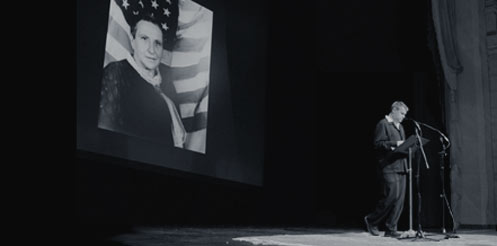
The evening consisted of nearly 20 readings, one right after the other, with an intermission halfway through – all in all, three hours. “Howl” tribute or not, you might expect a little shifting in the chairs, a little text messaging, maybe some early departures. But, no. Each reading was given its due respect and the pieces were so thoughtfully selected and moving that the audience seemed rewarded for its good behavior with one gem after another. As each reader spoke, photographs of the featured author were projected onto a screen behind them.

Some highlights:

New York writer Cintra Wilson, formerly of San Francisco, got things off to a saucy start, walking on stage in a figure-hugging, two-piece skirt and jacket ensemble. Hair up, retro cat eye glasses atop a well-powdered nose (think sexy librarian). Her enunciation was perfection as she delivered some amusing word definitions, taken from Ambrose Bierce's The Devil's Dictionary .

Armistead Maupin, who followed Cintra Wilson, began, “Sitting on the side, looking at Cintra Wilson's ass is enough to turn a gay boy straight.” This joke took on a life of its own as several readers throughout tweaked it to best describe the derriere of the reader that preceded them. The Tales of the City author proceeded to read a Mark Twain piece on the 1865 earthquake, “back when it was still known as The Big One.”

Jerry Brown, dressed in a dark suit and silver tie, read from Jack London's The People of the Abyss, a moving commentary on poverty and the conditions of paupers and children in ghettos. The Oakland Mayor finished, adding, “It's pretty heavy, but it's still going on.” Jack London was also an Oakland mayoral candidate.

Daniel Handler, creator of the Lemony Snicket series, read from Gertrude Stein. He told the audience that on her deathbed, Stein reportedly asked, “What was the question?” He also announced, as he first stepped up to the microphone, that “looking backstage at the ass of Jerry Brown, it's enough to turn a straight boy gay.”

Eddie Muller, nicknamed the “Czar of Noir,” read from Dashiell Hammett, doing a fine impersonation of The Fatman as he purred the famous opening line, “Ah, Mister Spade…”

And so on and so forth…like I said, each reader presented a gem.

Michael McClure, now 73, still lives and teaches in the Bay Area. Handsome in black jeans and blazer, his silver white hair tousled back, he came out and bowed to the audience. The youngest of the original poets from the Six Gallery reading, McClure read four of the same poems he read that evening in 1955, including “For the Death of a 100 Whales.” Intense and dramatic, hands gesturing, McClure read with focus and passion. Of that historic evening, he said, “We knew it instantly…that we had created a spark.” Of “Howl,” he said, “It was a poem about the nature of a new society in America.” And of the night's celebration, he joked, “There are more people here tonight.”

I was surprised and saddened that the entire audience did not give McClure a standing ovation. I mean, I know San Francisco audiences are subdued but, People, C'mon! It's one of the original six. It's 50 years later. He's reading the same damn poems. What's it gonna take?

Realizing that no one could read Ginsberg better than Ginsberg, the organizers arranged for the final reader to be the man himself (on video) reading from “Howl.” The footage was from 1992, for the documentary The Life and Times of Allen Ginsberg by Jerry Aronson. The filmmaker put together this short excerpt especially for the Howl Redux reading.

The Litquake evening may not have brought about revolution as it did 50 years ago, but it gracefully ushered in a week devoted to celebrating the city's current literary renaissance. Jack Boulware, Litquake's co-director, announced during the show that the mayor's office had declared October 7–15 Litquake Week. So now it's official. Litquake will, no doubt, continue to energize the city's literary scene, showcasing new works by contemporary writers, and providing a space for those who still remember how to, you know, howl.