Wednesday, July 2, 2008

Wild Women Writing: A Treasure of Tips from Travelers' Tales' Larry Habegger

By Cindy Bailey 5.1.06 (for 3.1.06)

The first Wednesday of every month, the Wild Writing Women host a free literary salon with a featured speaker at the Monticello Inn in San Francisco, and – as with so many other events – I kept meaning to go but didn't.

And then finally, after a year, I did. On March 1 st . That month, the Wild Writing Women featured Larry Habegger to speak on the art and craft of the personal travel story. Famous for starting up the award-winning Travelers' Tales series ( www.travelerstales.com ) along with James and Tim O'Reilly, Habegger is also an accomplished travel writer. I had heard him speak at San Francisco's LitQuake, and I remembered I liked him. I really liked the Travelers' Tales books, too.

The salon would start at 5:30. I had just enough time to make it. There was only one problem. What would I do with the three-month old baby sitting on my lap? (This, by the way, is the reason I'm only getting to a write-up of the event now. Who knew having a baby would consume so much time you'd be lucky to sneak in a shower, let alone find a moment to write?) Either Julien came with me, or I didn't get to go. I had no choice.

I strapped Julien to my chest and ran out the door. At the Monticello Inn, it was easy to locate the salon by the 30 or so writers (both men and women) mingling in a cozy section of the lobby. The room had cushy couches and chairs, warm rugs, and a fire place. Wine was being served. Julien had fallen asleep, and so I sort of pretended he wasn't there, grabbed a glass of wine, and took a seat near the back.

Julien, however, did attract attention. Pamela Michael, one of the Wild Writing Women and the host of that night's event, asked me if this was the baby's first salon (bless her), and Larry Habegger approached to ask about Julien and chat about traveling with young children, which we agreed is doable.

After socializing ended, Michael took to the microphone and made some announcements. She then introduced her guest, telling how she had interviewed Habegger for the travel show she hosts on KPFA radio here in San Francisco.

Habegger opened with a colorful story, the details of which are a blur to me now. I believe it began with how he knew Michael, and how he was on his way to the interview when one of Berkeley's crazy people harassed him, truly frightening him for his life. Interestingly, the topic of his radio interview was safety while traveling, and the point of his story now was that safety is relative. You might just as likely be killed in some sketchy, foreign land as you would walking down the street here at home.

His story served as an opening for, and a perfect illustration of, his first writing tip, which was that a travel story should be part essay (the point you want to make), part memoir (the telling details about your experience), and part conversation (which I took to mean, making the story relevant to your audience). I had never heard it put that way before, and found this to be a clear and fresh perspective on an age-old art.

Other writing tips he shared:

• Write for yourself always, and then (afterwards) change the form to meet requirements.

• Apply fictional techniques to your stories.

• Write to your life message; in other words, consider what you want others to get from your writing.

For when you're just starting out, Habegger had these tips:

• Be the best writer you can be.

• Be as professional as possible when dealing with editors. (Know what they want and have your contact information.)

• Get to know as many people as you can in business (because access is just as important).

• Read.

After his talk, he read from the latest Travelers' Tales book, doing what one of his contributors did at LitQuake: he read only part of a story, leaving you to salivate for the rest. So of course, you had to buy the book!

During the follow-up Q&A, Habegger shared more tips in the form of common mistakes writers make: overwriting, becoming too personal so that it's all about you (it has to be about something bigger), weak language, weak story, and a few others.

His talk was both practical and engaging. A treasure of valuable tips. I sensed – from our conversation earlier and from his talk – that Habegger is a warm, generous person and teacher.

Just as the event wrapped up, I felt a stirring on my chest. Amazingly, Julien had slept through the entire talk. He must have known how desperately I needed the escape.

When I got home, I realized that the question I should have asked Habegger is how in the heck do you write with small children. That did not seem doable. I'm sure he would have had some sage advice for me on this, too.

For the next monthly salon, check out www.wildwritingwomen.com . If you want more of Habegger's pearls, consider taking one of his classes. See www.larryhabegger.com .

Cafe Prague

By Wayman Barnes

I have been to a lot of poetry open mics in my day, but never one like the one at Café Prague. This reading is … different. There is no stage. No microphone. No sign up sheet. Nothing to tell you that something is happening.

The host sits at a table in the middle of this restaurant. He speaks in a loud, bombastic voice, so there is no way to ignore him. People who are there just to eat the goulash find themselves in the middle of a show whether they want to be or not.

As I walk in, there is a thin, timid man with a long beard begging to be allowed to read. The host is being obstinate, but, finally, after much negotiation, lets him perform. As the bearded man performs his poem, the host makes comments, jokes, asides, and grunts of approval or disapproval for each line of the poem. I keep expecting someone to tell him to shut up, but no one ever does. It soon becomes apparent that he does this all the time. Each poet gets heckled in turn, and it is all just part of the show.

Café Prague is a restaurant/coffeehouse in North Beach near the City Lights bookstore. The interior is dark and the staff friendly (and cute). The menu is filled with a variety of Czechoslovakian dishes. I order the apple strudel, but make note to return sometime for some dumplings or goulash. Both look very yummy. During the poetry reading, the place is very full. I can't tell who is there for the reading and who is there just to eat. Whenever one poet finishes reading another poet stands up and asks to read. If the host says it is all right, the poet performs at their table. I wonder what the nonpoetry people make of all this. Is it just taken as being part of the San Francisco experience?

Which, I must say, is part of its charm. It feels like what I'd imagine the readings to have been like back in the days of the beatniks. I wouldn't be surprised if there was a similar type of reading taking place in this exact same coffeehouse. There may have even been a loud, opinionated host critiquing each poem's worth, heckling the poet, and spouting off on the politics of the day. All while people are sitting around trying to enjoy their dinner. I can't imagine a reading being any more Beat than this one. (Maybe, if there were berets, bongos, and finger-snapping happening, but as far as I know, that was just the Hollywood version).

If you were around back when North Beach was the center of the Beat universe, please go to this reading and tell me if it is anything like the readings back then. For those people like me, who have spent lots of time reading about the Beats and wishing you could have been around back then, go to Café Prague. It might be as close as you'll get to be a part of that history.

And the apple strudel is good, too.

Monday, June 2, 2008

The Ever Prolific Michelle Tea

By Cindy Bailey 11.22.05
Photo by Lydia Daniller

Michelle Tea is a burst of positive energy. Vibrant as the colorful tattoos that run the length of her arms. Alive, impatient, and prolific. Her writing is rich with story and brutally honest. And as a literary leader, she's helped define and shape a local underground subculture of queer women writers and artists.

When I say prolific, I mean: she's written four memoirs, including the award-winning Valencia and her latest, Rent Girl , an illustrated graphic novel she created with illustrator Laurenn McCubbin that details her former life as a sex worker. She's published one book of poetry, The Beautiful , and was editor of two anthologies, plus a guest editor of a third. She contributes regularly to numerous anthologies and publications, such as On Our Backs , Girlfriends , The Believer, and The San Francisco Bay Guardian , and her first novel, Rose to No Man's Land, will be coming out in February, 2006.

In addition, she also writes horoscopes, along with Jessica Lanyadoo, for The San Francisco Bay Guardian and other publications.

She's won numerous awards for her writing, and yet she's sometimes more known for her literary shows than she is for her writing. Tea currently runs the popular monthly Radar Reading series at the San Francisco Public Library, and she is also the creator, along with Sini Anderson, of Sister Spit, a girls-only open mic event that ran from 1994 to 1996, and then hit the road on tour across the country from 1997 to 1999. Winning The San Francisco Bay Guardian's Best of Bay award for “the best place to hear sliver-toungued she-devils,” Sister Spit helped cultivate the talents of many women writers and performers, such as Beth Lisick and Tara Jepsen.

Tea has also gone on tour with the Sex Workers Art Show and The Wasted Motel Tour, among others. “I do other tours mainly when I have a book coming out,” she told me. “I don't drive, so I have to curate this whole show, and then find people to drive.”

I sat with Tea (and her cat) in her apartment in North Beach to chat about her writing life.

I read you always wanted to be a writer. How did you get started? And when?

I got started when I moved to San Francisco in '93. I had just come out of this really screwed up relationship, and I needed something to devote myself to. I just decided I'm going to go to San Francisco and I'm going to write.

So when I came here, I started going to open mics. There was one every night of the week, and there were people there who had a sensibility I could relate to. They weren't coming out of universities. It was a really working class sensibility, a punk-informed sensibility. They were happening in places [where] I felt really accepted and comfortable, like bars and coffee shops. As intimidating as it always is to get up on stage, especially when you haven't done it before, it was the least intimidating way to do it [get my writing out].

So you chose the open mic scene as opposed to staying in your room and writing.

Yeah. I never wanted to do that. That would have felt very futile to me. I'm a really sociable person, and I didn't want my writing to just sit. I didn't want to write for no reason. I wanted to have an audience or have my writing be out in the world, but I had no idea how to do it. It was so wonderful that I didn't have to think about it for too long. I came, I found this scene, and I thought great, this is totally what I want to do. I didn't even know what I was looking for, but this was totally what I was looking for.

How did you choose San Francisco?

I flipped a coin. It was between here and a lesbian separatist land in Arizona. My girlfriend and I broke up, and I had been kind of obsessed with this really bad relationship. I was really young, and I didn't know what to do with myself when we broke up. My best friend from when I was younger lived out here, so I flipped a coin and came and stayed with them.

Did you start with poetry?

I did.

And you took those to open mics?

Yes.

How did you decide on a genre, like poetry?

I didn't. It's just kind of what came out of me right then. I wanted to tell stories about my own experiences, and poems were the way they came out. Little, fired-up emotional blurts was kind of where I was at and how I was able to get a handle on what my material would be. They were pieces that I could write at work, or in between working and not working. They could just occur to me when I was walking down the street. I could stop and jot them down.

I was so overwhelmed by my life at that time. I had just moved here, I didn't know what I was going to do, and I was contending with both this brand new present and my past, which I felt I really needed to look at and understand. There was a lot of mental activity, and poems were a really good way to get the burst out.

How is it that you also became a performer, and which came first: writing or performing? Or did they go together?

Writing came first because you have to write the thing before you get on stage. Performing was just a way to release my writing, a way for me to be a part of a writing community, to let people know that I exist, to hear what the work sounded like, to give it a certain life. I was also selling my chapbooks, so there was a written page aspect to it too.

How much did your home/family life influence you as a writer and how?

I write memoir, so the activity of home and family life have influenced my material.

Did your home or family life push you to become a writer?

I think I was just born a writer. I really do. I always felt the urge to be writing and documenting. I remember being six years old and just having had an operation, and trying to write a book about a girl who just had an operation. I think whatever family I was born into would have wound up fodder for my writing. It's so mysterious. We never really know, you know? Maybe if I had different genes, I wouldn't be a writer.

But being a writer is just like, so out there. … I wasn't encouraged to do that, but it was more because it just seemed like encouraging someone to go and be a movie star. Who gets to do that?

Why did you move from poetry to prose?

I felt like the form of poetry couldn't contain the story I wanted to tell. I wanted to shine a wider light on people and incidents that I had been touching in my poems.

Do you still write poetry sometimes?

I don't. I don't have the mental space to let a poem in. I feel like life the way that it was… I just had a lot of open space to dream, and I think that's what you need for poetry.

You do so much. How do you choose projects to take on? You write books, edit anthologies, run events. How do you choose?

Sometimes I choose me a little. I've always been curating shows. I like curating shows as much as I like writing, so I have to be doing that to be happy, and to feel like I'm doing something I'm supposed to do. So, doing Radar [Reading series] is perfect because it's once a month. I couldn't do a once a week thing anymore.

And I need to be working towards a new book at all times. What I'm working on now is a script for a comic book that I'm doing with Laurenn McCubbin, who illustrated Rent Girl . We went on three regional tours for Rent Girl . … We got great responses and felt really buoyed by that. So, we felt we've got to do another project together. So we're doing this. That's what I'm working on, and I'm taking notes for other possible things.

But I have to be working on a book, and I have to be working on a series. For other stuff, people ask me to do things and I either do them or I don't.

How do you manage your time among the many different projects?

I do manage my time. I have to designate some days working days and some days off. On most of my days off, I end up doing some work – it's inevitable. But on my work days, I definitely don't lounge about. … What I work on is dependent on whether or not I have a deadline for one of my paid writing things. If I don't, then I will work on creative stuff. But I don't do as much creative writing as I would like to.

On my days off I don't let myself return any phone calls or check emails. I still end up doing that sometimes, but it's OK if I don't. I just have to make peace with the fact that I can't keep up with the emails. [Otherwise,] that's all I'd be doing.

When I first started writing I was such a devout slacker. I was against the idea of having a career. I just wanted to be an artist in the world and experience the world and write. So it's funny now to just feel like I have all these responsibilities. Sometimes I have to realize, ‘No, remember how you were?'

What is your writing process? Does it depend on the type of writing project?

I think so. It really does. My process for writing all my memoirs was really different than my writing process now. I would have a running list of various things I wanted to explore, either a person or an incident, anything that got my inner narrator running. …I'd have a list inside my notebooks, and I would go to bars and cafes after work and write until they closed.

I didn't set out to write a certain book. I was just amassing all these stories. Because they had a consistent narrator, they ended up becoming books. I would just have to look at it and say, ‘OK, all I have to do is fill in these gaps, and that's a complete book.'

But now, writing fiction… I don't drink anymore, so I don't write at bars anymore, so that's really changed my writing process.

I think writing fiction is hard.

Yeah. It was. Writing Rose of No Man's Land was crazy because I didn't know what I was doing. I didn't have any faith that I could actually do it. I was really preoccupied with whether this character is believable, is this realistic?, all this stuff that now, I don't even care. It's fiction, it's OK to write a character that wouldn't really exist in the world. But I am just so into this authenticity mode from writing memoir that I'm like, is she real?

I didn't have an outline. I'd just sit down in stark terror and make them [the characters] do things. It's a really manic book... And now, I feel like, oh-my-god, I will not write fiction without some sort of chapter outline or chronology or something to work off of.

I mean, I could do it like that again. At the end of it all, I really like the book. It works. But I think it would be easier on me psychically to have something to work from.

So when I started working on the script for the comic book, I ended up spending three months just really getting back story, developing characters, putting together a timeline of activities, and that's what I'm working from now.

… And it's not like you can't go off of your plans. But it's very comforting to have a structure.

Do you write every day?

No I don't. I could probably benefit from some more discipline in that, but I just kind of get up on a work day and try to figure out what I feel like doing, what I've neglected, what deadlines I have. Today so far, I read some stories for the anthology and invited some more people to participate in those. I checked some emails, made some phone calls. I have some deadlines tomorrow. I'll probably do non-creative writing today.

But oh, I also have a writing duo, in which once a week I meet with a friend who's a writer who's also working on science fiction – very fantastical, creative writing, and that's what the comic book is, fantastical. So we meet once a week and write. I just did that last night, and I feel I got a lot of really good creative writing in.

Do you set goals for yourself? How do you motivate to write?

I have to write at this point because if I don't I will have no money. Before that I felt I had to write or I'd have no life. I was just working these crappy jobs, and I just knew that if my life was going to have any sort of meaning or if there was an opportunity for it to ever get interesting, it was going to happen via my writing. I just really wanted to participate in the world, and it seemed to me my only in. So I was really motivated that way.

So now, OK, I'm in. I've got to keep it going. I know that I have to keep producing; it's the only way to stay in the game.

… Deadlines imposed by other people are great. I can't impose them on myself.

What inspires you and keeps you writing? Is it this idea of being a participant in the world?

Yeah, that's the base motivation for it. And then there's what inspires actual stories. Those are two different kinds of things.

What was your first break as a writer?

Hhm. I think probably starting the Sister Spit open mic because it gave me an audience. Even though it was a local audience, it was an enthusiastic and devoted audience. It let me know there was a way I could be a writer even though I hadn't been published, which seemed like so out there for me. But I kind of gave that to myself in a way. Getting my first book published, that was a really big deal. That I suddenly had a published work was crazy.

And then there was another break: Valencia winning the Lambda award, and getting published under MacAdam/Cage Publishing with my next book feels like a really big break.

They're all so intertwined, it's hard to pick which one is the big one.

What have been your biggest challenges or obstacles, either in your career or writing process?

I think the biggest challenge is to challenge yourself and not rest in stories or themes or ideas that you know, that have worked for you in the past. I felt I really had to write fiction, even though a lot of the ideas and themes in the fiction are present in my memoir. I had to do something different, because I could get trapped in the talking Michelle Tea puppet, writing about my own life again and again and again.

How did you fall into writing for the various anthologies and publications that you do, in general? Do people come to you with them?

Yeah. Entirely. That's how it's happened. I'm asked to write one thing, and then I just ask, can I keep doing this? Can I write more?

I did go to Girlfriends and ask them because I was asked by this other, competing lesbian magazine to write a weird soap box essay. I ended up writing this really weird essay about how – and granted I was out of my mind at this time – I decided not to wear a pad or a tampon for a period and just bleed all over everything and make the world deal with women's menstrual blood. … They wanted to take all these parts out. I said, come on, you're a lesbian magazine. So, I got really upset and contacted their competitor, which is Girlfriends magazine. Will you publish this? And they said yeah, and I've been writing for them ever since.

But all the other ones I was contacted by them, and once I had that contact, I just kept using it.

How about making a living as a writer. Do you feel you've been able to do that?

Yeah, amazingly. I'm completely doing that, and I've been doing it since 2003, which is when I quit my day job, which kept getting pared down. I was terrified to let go of it (working at a bookstore, which I had been doing for about five years). I was getting invited to speak at different colleges, and there was this one month where I realized if I kept the bookstore job, I wouldn't be able to do all these other readings and I'd actually be losing all this money. It just kind of happened like that. Things kind of converged. I went on the Sex Worker Art Show tour, which I got paid to be on, and then I got an advance to do the Without a Net anthology, and suddenly I had the little safety net to be able to freelance. Because your check takes a while to come in, you need to have a little egg to live off of while you're waiting, and I never had that. Then I did.

All the things that I do together support me, but any one of them on their own would not. The books alone don't support me. The horoscopes and articles don't support me. The going to speak at colleges and doing paid readings don't. But all of them together do. For Radar [Reading series], I've gotten a couple of grants, last year and this year, and that's made a huge difference.

What advice would you give a writer who wants to follow in your footsteps?

In my footsteps? They're very specific footsteps. There's a lot of different footsteps you could follow in. I think it's really important to not be goal-oriented, to not have expectations, and to really focus on your writing. Of course you want to get published. Of course you want success. But that can't be the focus. I just know people who get wigged out over their writing careers, and I think if you get into that state, no matter how many good things happen to you, you're just in that state.

I just feel you need to keep your feet on the ground, and you need to know you're just another writer in the world, and you've got your thing to say, and you're going to figure out how to say it and do it. If you don't see a space in the world for you and your writing, then create it. Start a reading series if you feel you can't get in on other people's reading series. If you feel alienated, do something. If you feel you don't have publishing connections, publish your own book and get it out. Every little thing you do like that is a step, and you can build on it. It's not like that's all what you have to do for the rest of your life. I just feel if you can take it into your own hands and be more do-it-yourself about it, the more empowered you're going to feel, and the more you'll be able to devote yourself to the actual writing and not get hung up on rejection letters and stuff like that.

What does the future hold for you? Do you have an ultimate goal?

Well, there's things I'd like to do, I just try not to get too attached to them. Yeah, there's a lot. What's coming up is that I'm going to do this Sex Workers Art Show tour in the winter, and my book, Rose to No Man's Land , is going to come out while I'm on that tour, so when I'm done I'm going to be doing a book tour. Hopefully by then I'll be done with the comic book, for which we have an agent who's working on selling it for us, and then I'll be able to write either another novel or I'll try a memoir again.

But also, Laurenn [McCubbin] and I have optioned the rights to Rent Girl to the executive producer of Queer As Folk , so we're really hoping that we're able to meet all the right people and have it all come together so that we can have that made into a cable TV show – that we would participate in and write for. He's having a hard time right now finding people who are open to the idea of a TV show that's all about prostitutes because the media idea is that it's … really sad and pathetic and depressing.

I think it would be fascinating for people who have no exposure to it.

Totally! It would be so great. It would be an incredible and revolutionary show, and I totally believe it's going to happen. I just hope it's going to happen soon. I am trying to kind of weasel my way into television in Los Angeles. I pitched to one production company a bunch of ideas, and my sister and I wrote a really thorough outline for a TV show.

How do you keep track of all these projects?

It's hard. It helps that there's so much going on because things in L.A. take forever. It's so slow. So it's good that I've got a lot to do here or else I'd be wigging out and neurotic.

Yeah, they have a lot of people get involved in the decision making process down there.

Yeah, and you're relying on other people. It's really good to have things that I don't have to rely on anyone for, that I'm in control of, and I know that I can make things happen.

Wednesday, May 7, 2008

The Kitchen Sisters

11.21.05

There were clues early on that this may not be the typical book reading at A Clean Well-Lighted Place for Books on this Monday night in San Francisco. The small space was transformed - the podium possessed not one, but three microphones and ample-sized speakers stared down at the audience. Easels with montages of glossy posters flanked the podium. Off to one side, platters of tasty finger-food and bottles of wine stood waiting. I overheard light-hearted apologies for the food: “Well, it's not from the stove in the kitchen.”
People started streaming in. The local celebrity vs. average book buyer ratio was climbing by the minute, unusual for this casual, cozy venue. Armistead Maupin, Alice Waters, and Don Novello were among the group. This was a reading to celebrate the release of Davia Nelson's and Nikki Silva's book, Hidden Kitchens, and the two warmly greeted the attendees they knew, which seemed like half the crowd. It had the feel of a reunion of close-knit friends. My thoughts echoed the palpable sentiment: Nelson and Silva, both Bay Area residents, are beloved and admired in this community.
Nelson and Silva, known as The Kitchen Sisters, have been a story-telling team for radio productions since 1979. They created the Hidden Kitchen radio series for NPR's Morning Edition, the basis for their book. They kicked off the event by reading a passage about the inception of the Hidden Kitchen radio series. The passage recounted how, in San Francisco, Nelson happened to keep riding in taxis with drivers who came from a Brazilian town called Goiana. Conversations eventually led to discovering the hidden kitchen of a Brazilian woman who would stake out her tent-kitchen near the taxi company's office late each night. Nelson and Silva conducted interviews amidst the Brazilian music and Portuguese banter, and then broadcast the story. This led to a request for other hidden kitchens, resulting in 2,079 messages. A radio series was born.
We then heard the taped voice of George Foreman, heavyweight boxing world champion, boom from the speakers. He said, “I dreamed of having enough to eat.” This childhood memory morphed into the production of the very popular George Foreman Grill. We listened to taped testimonials from people living in SRO (Single Room Occupancy) hotels or living on the streets, passionately describing how the grill is a safe and affordable way to cook. Another type of hidden kitchen.
The authors injected spontaneity by surprising a few of the local celebrities with requests to read. Don Novello, the former Saturday Night Live's character Father Guido Sarducci, read the passage about a man who spoke lovingly about his memories of his “Big Grandma” and “Little Grandma.” Novello, who has a deep voice and rich accent, described how the grandmothers' styles of cooking reflected how they lived their lives and ultimately, how they died.
“Lou the Glue” Marcelli, an imposing 77 year old with a sturdy build, captivated the group with his own hidden kitchen story. As the custodian for the Dolphin Club, a San Francisco Bay swimming and rowing club founded in 1897, he frequently cooks his legendary calamari pasta with tomato sauce, among other dishes, for the old-time members who want to tell their stories, drink wine, and eat his food after a swim in the bay. Affectionately referred to as an “old stove,” he's been cooking for the community for decades. Marcelli swims in the bay four days a week without a wetsuit, regardless of the weather. He said, “You just look it [the water] in the eye and go.”
Armistead Maupin, writer and author of the book series Tales of the City , was asked to read message #341 from a woman living in Milwaukee, Wisconsin. As a lesbian, she had felt isolated until she heard of local potluck dinners. Maupin then quipped, “I wonder why I was chosen to read this one.”
We next listened to a taped story from their broadcast. While listening, wine was served to the audience. This was no ordinary wine. It was homemade by “Angelo” who is also featured in the book. Nelson and Silva serve his wine at all their readings, no matter how cumbersome to transport. His hidden kitchen is in his wrought-iron forging studio in an industrial part of San Francisco where he cooks food inspired by his Sicilian upbringing.
Alice Waters, owner of the Chez Panisse restaurant and founder of the organic and local-grown food movement, was last to read. (Waters wrote the foreword for the book.) She read a story about a woman who fondly remembered a Long Island fisherman selling fresh fish from his cart.
Nelson and Silva took questions before signing books and closing the reading. The authors' knack for engaging radio listeners transformed a rather predictable literary format to a much larger experience. Heartfelt cooking and feeding others has a unique power and magic to soothe and create community where it doesn't exist. The authors showed us that connection.

Tuesday, May 6, 2008

Poetry & Pizza

By Wayman Barnes 11.4.05

Maybe I should have been paying closer attention to what was happening, but when the poet said he would be doing his “zone out pieces” he wasn't kidding. My mind was somewhere else entirely when I noticed most of the audience was walking out the door. Had I missed something? The host was still at the microphone introducing the next poet. She was standing over to the side with chapbook in hand ready to go on. The show was clearly not over. Yet, all these people were being extremely rude. Had the previous poet been bad enough to have caused this mass exodus? I couldn't bring myself to look over at him. What must it feel like to know your poetry has cleared a room? I can't imagine (and I hope I never have to find out).

Although I had not been listening to the poetry, I had been enjoying myself. The reading was called Poetry & Pizza, and, in my humble opinion, names don't get any better than that. As soon as I saw the ad I knew where I was going to be on Friday night. I figured if someone was going to go to the trouble of combining my two favorite things together, the least I could do was show up.

For some reason I imagined the reading would be at a hard-to-get-to, greasy, mom and pop pizza joint filled with finger-snapping teens doing wannabe hip-hop or “imsoanguished” diary-style poetry, but it was neither. To my surprise, it was slightly upscale. The venue was an Escape from New York pizza restaurant (nicer than all the other ones around town) in the Financial District. There was even a poem by Galway Kinnell written across one wall (“If one day it happens …”) and a jazz guitarist playing. Some of the audience members were dressed in the obligatory black and I must admit I started feeling a bit intimidated. I was afraid that I might have to actually use my brain.

The restaurant had been closed at 6 and reopened for us at 7. The admission is a five-dollar donation, which includes the reading plus all the pizza, salad, and coke you want. I later found out that all the money would be going to a charity of the Featured Poet's choice – on this night it was going to the Zen Hospice. After several servings of gourmet pizza (Potato, Pesto, and Garlic – crazy!) this reading was already an A+ in my book.

Unfortunately, the poets weren't as good as the pizza. By their own admission, they were not performers. This was evident, not so much in how they read, but in how they used the microphone. They would either hold it too close or too far away which made their voices garbled and hard to understand – never a good thing when listening to poetry.

Every reading has an off night, and, judging by the size of the crowd (the place was packed at the beginning), I am assuming this had to be one. I will certainly be going again. The fact that it is being done for charity is reason enough for me. I think it is important to support a show like that. Besides, with a reading called “Poetry & Pizza” there is always a 50/50 chance that you will like at least half of it.

*The reading on December 2nd will be an Open Mic.

Litquake 2005: Humor at the Purple Onion

By Cindy Bailey 10.11.05

What better place to host a gaggle of humorous readings than at the Purple Onion, San Francisco's landmark comedy club in North Beach? I'm talking legends have performed here: Lenny Bruce, Woody Allen, The Smothers Brothers – all at this original location. Today, the place still has that intimate feel, with low ceilings, dim lighting, cozy booths, small tables, and the periodic, comforting sound of the martini shaker coming from the bar. The perfect setting for Litquake's Humor Me event (Litquake being San Francisco's annual, week-long extravaganza of literary events).

While we waited for the room to fill and the show to start, Purple Onion's regular maestro, Geoff Foster, played (and sang) beautiful ballads on the piano. Once we were huddled cozily and well into our two drink minimum, Jane Ganahl, co-founder of Litquake, took the stage. She talked about Litquake, thanked the sponsors, and introduced the emcee, Bucky Sinister . And the show began.

Sinister, in his T-shirt and tattoos, holding the microphone in his fist and bursting all over the stage, opened the evening with – of course – a few jokes, saying he could just hear Lenny Bruce tying off in the bathroom (Lenny was a heroine addict). Sinister also wondered why if Hunter S. Thompson “was going to off himself anyway, he didn't do it by taking a shot at G.W.” He speculated that “that would make being Republican dangerous again.”

And then on with the readings.

Firoozeh Dumas , author of Funny in Farsi , read a hilarious story of finding a potato in the shape of a cross and deciding to sell it on Ebay. Her family knew it was worth $60,000, but also knew that “large starting bids were the death on Ebay, and so we started the bidding at $5.”

The suave-looking Ian Lendler took the stage next, appropriately dressed in cocktail lounge attire to read from his book, Alcoholica Esoterica , the subtitle of which is “A collection of useful and useless information as it relates to the history and consumption of all manner of booze.” He chose to read about champagne, and how it came to be. We're not talking boring facts and historical dates, here. We're talking about a fascinating tale with a lot of humor interwoven throughout.

“Hipster humorist” Mal Sharpe said he's been pulling pranks since the early 1960's. He took us along with him on one of those long ago pranks and got the biggest laughs of the night out of me. First, he showed us the soft briefcase he used to hide the tape recorder and mic, and then he told us how he and his prankster-buddy walked into a pharmacy and asked the pharmacist for some sterilizing products because he (prankster-buddy) was going to operate on his friend's (Mal's) heart. He read the books, doesn't look so hard, it's doable. The reaction of the pharmacist, who voiced genuine concern and restrained outrage, was hilarious.

At intermission, Sinister entertained us by reading from his latest book, Whisky and Robots , telling us the difference between rednecks and hicks and the paradoxes of Nascar.

Jack Boulware , co-founder of Litquake , read a story about shopping for his mother's coffin, saying that he was continuing the redneck theme. There were taxidermy animals lining the walls of the funeral home, because this is southwest Montana after all. Loved one of his character's names: Butt-Crack Todd.

Writer and performer Merle Kessler (aka Ian Shoales) read a number of funny short pieces: one about an outbreak of politeness in San Francisco, and another in which he takes on the role of a 27-year-old applying for a job as a radio talk show host to replace Howard Stern.

Finally, Beth Lisick , author of Everybody Into the Pool , read a hilarious selection from her book, one about visiting her in-laws. She read that her parents and her husband Eli's parents do have something in common in that “they both live in a house with a roof on top” – and you get that similarities end there. On their visit, Mom Penny took her girlfriend Caroline to a “fisting” workshop (as in how to place a fist into a vagina) while gay Dad complained about not being told there would be boys at this fair. Beth gave us her usual high-energy reading.

In closing, Sinister, full of expression, read another comical selection from his book. In fact, all the readings were animated, and very entertaining.

Saturday, May 3, 2008

Litquake 2005: The Hip Revisit of Howl

By Vené Franco 10.7.05
Original Photo by
Derek Powazek

In the words of our emcee, Jack Boulware, “Is it hot in here or is it me?” Well, it was both as nearly 1,000 literary fans packed Herbst Theatre for the opening night of Litquake and its Howl Redux presentation.

The event kicked off the Litquake 2005 schedule and marked the 50 th anniversary of the debut of Allen Ginsberg's epic poem “Howl”—a literary milestone credited as giving birth to the Beat movement. With a crowd somewhere between 150 and 200, the original reading—hosted by poet Kenneth Rexroth—took place across town at a small space known as Six Gallery. That location, 3119 Fillmore Street, is now home to a furniture store but has a new plaque marking its place in SF's literary history. According to the original promotional postcard, the reading was titled 6 Poets at 6 Gallery. Featured poets included Philip Lamantia, Mike McClure, Allen Ginsberg, Gary Snyder, and Phil Whalen. And among those attending were Jack Kerouac, Neal Cassady, and Lawrence Ferlinghetti. The postcard read, “…remarkable collection of angels on one stage reading their poetry. No charge, small collection for wine and postcards. Charming event.”

Litquake's Howl Redux proved itself as far more than just homage to Ginsberg and “Howl.” It was a celebration of several other revolutionary Bay Area authors, including Mark Twain, Dashiell Hammett, John Steinbeck, Jack London, Jack Kerouac, Gertrude Stein, Ambrose Bierce, Lawrence Ferlinghetti, Randy Shilts, Ken Kesey, and Iris Chang. The lineup of celebrity readers was equally impressive and included Oakland mayor Jerry Brown, Armistead Maupin, Amy Tan, Michael McClure, James Dalessandro, Daniel Handler, Peter Coyote, Cintra Wilson, Andrew Sean Greer, Eddie Muller, and devorah major.

An admitted literary groupie, I was waiting for the doors to open promptly at 7 p.m. After a good hour of people watching, I stopped counting black berets after the first dozen and noted several people walking in with their own copies of “Howl.” The crowd included a few senior hipsters, and I wished there could have been a show of hands to see how many, if any, were in attendance on that night in '55. Was it really as magical as they say? And, to be honest, did anyone go home with Kerouac? How about McClure?

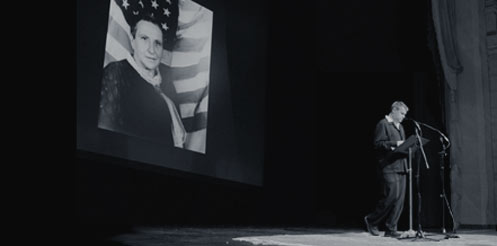
The evening consisted of nearly 20 readings, one right after the other, with an intermission halfway through – all in all, three hours. “Howl” tribute or not, you might expect a little shifting in the chairs, a little text messaging, maybe some early departures. But, no. Each reading was given its due respect and the pieces were so thoughtfully selected and moving that the audience seemed rewarded for its good behavior with one gem after another. As each reader spoke, photographs of the featured author were projected onto a screen behind them.

Some highlights:

New York writer Cintra Wilson, formerly of San Francisco, got things off to a saucy start, walking on stage in a figure-hugging, two-piece skirt and jacket ensemble. Hair up, retro cat eye glasses atop a well-powdered nose (think sexy librarian). Her enunciation was perfection as she delivered some amusing word definitions, taken from Ambrose Bierce's The Devil's Dictionary .

Armistead Maupin, who followed Cintra Wilson, began, “Sitting on the side, looking at Cintra Wilson's ass is enough to turn a gay boy straight.” This joke took on a life of its own as several readers throughout tweaked it to best describe the derriere of the reader that preceded them. The Tales of the City author proceeded to read a Mark Twain piece on the 1865 earthquake, “back when it was still known as The Big One.”

Jerry Brown, dressed in a dark suit and silver tie, read from Jack London's The People of the Abyss, a moving commentary on poverty and the conditions of paupers and children in ghettos. The Oakland Mayor finished, adding, “It's pretty heavy, but it's still going on.” Jack London was also an Oakland mayoral candidate.

Daniel Handler, creator of the Lemony Snicket series, read from Gertrude Stein. He told the audience that on her deathbed, Stein reportedly asked, “What was the question?” He also announced, as he first stepped up to the microphone, that “looking backstage at the ass of Jerry Brown, it's enough to turn a straight boy gay.”

Eddie Muller, nicknamed the “Czar of Noir,” read from Dashiell Hammett, doing a fine impersonation of The Fatman as he purred the famous opening line, “Ah, Mister Spade…”

And so on and so forth…like I said, each reader presented a gem.

Michael McClure, now 73, still lives and teaches in the Bay Area. Handsome in black jeans and blazer, his silver white hair tousled back, he came out and bowed to the audience. The youngest of the original poets from the Six Gallery reading, McClure read four of the same poems he read that evening in 1955, including “For the Death of a 100 Whales.” Intense and dramatic, hands gesturing, McClure read with focus and passion. Of that historic evening, he said, “We knew it instantly…that we had created a spark.” Of “Howl,” he said, “It was a poem about the nature of a new society in America.” And of the night's celebration, he joked, “There are more people here tonight.”

I was surprised and saddened that the entire audience did not give McClure a standing ovation. I mean, I know San Francisco audiences are subdued but, People, C'mon! It's one of the original six. It's 50 years later. He's reading the same damn poems. What's it gonna take?

Realizing that no one could read Ginsberg better than Ginsberg, the organizers arranged for the final reader to be the man himself (on video) reading from “Howl.” The footage was from 1992, for the documentary The Life and Times of Allen Ginsberg by Jerry Aronson. The filmmaker put together this short excerpt especially for the Howl Redux reading.

The Litquake evening may not have brought about revolution as it did 50 years ago, but it gracefully ushered in a week devoted to celebrating the city's current literary renaissance. Jack Boulware, Litquake's co-director, announced during the show that the mayor's office had declared October 7–15 Litquake Week. So now it's official. Litquake will, no doubt, continue to energize the city's literary scene, showcasing new works by contemporary writers, and providing a space for those who still remember how to, you know, howl.